Showing posts with label Headphones reviews. Show all posts

Thursday, July 7, 2016

Sony MDR-1A review

    Sony's MDR-1A is the successor to the discontinued MDR-1A , a "premium" over-ear that we liked a lot when we reviewed it a few years ago.
That earlier model was known for being extremely comfortable, and the very similar looking 1A, which costs $300 (£170 UK, AU$400), is even more so, thanks to some small design changes. First, its earcup design is subtly different, with softer padding and cushions that are slightly angled to conform to your head better. The finish on the MDR-1A is also a bit more textured (stippled). It's a minor detail, but I did like it slightly better, but others may prefer the smooth finish of the MDR-1R.One of the biggest design changes is that the MDR-1A's earcups rotate in an opposite direction from the MDR-1R's. That's a big deal because the headphones can now rest flat (pads down) against your clavicles when you have them sitting on your neck. In other words, they feel a lot more comfortable when you're wearing them around your neck and not listening to them.


What you get in the box.

At 7.94 ounces (225 grams) without the cable attached, the MDR-1A is also slightly lighter than the MDR-1R (240 grams), which was already considered lightweight for an over-ear model. The headphone fits snugly but not too snugly and should fit a variety of head sizes well.
The other small design change is to the cable connector on the headphones. On the MDR-1A, the base of the connector is plated with a gold ring. No such ring exists on the MDR-1R.
In terms of accessories, you get two standard length 1.2-meter cables, one of which has a one-button inline remote and microphone. It's geared toward Android phones but also works with iPhones, though in a more limited capacity (no volume controls). If you have Android phone, you can use the free SmartKey app to customize the button controls.
A decent carrying pouch is also included and Sony also sells three optional higher end cables for this headphone if you want to try to eke out even better sound.

The headphones look very similar to the MDR-1R, but have some small design changes, including a slightly more textured finish and even more comfortable earpads.

Performance
You know it when you hear it -- the MDR-1A just sounds right. The balance of bass, midrange and treble is as smooth as can be, the stereo soundstage is spacious, and dynamic range is, well, dynamic.
What we're saying here is the MDR-1A is for audiophiles who want to hear the sound as accurately as possible, so there's no jacked-up bass or zippy treble -- the MDR-1A just tells it like it is. It's also one of the more comfortable over-the-ear headphones  around, so you can listen longer without fatigue.
Switching between the MDR-1A and the older, now discontinued MDR-1R, the new headphone sounded clearer, from the bass all the way through the treble. Switching back to the MDR-1R, the low bass was muddier, thicker, less clear; vocals and guitars are brought into sharper focus over the MDR-1A. The differences aren't huge, but they're there.
We next moved on to Audio Technica's ATH-MSR7 headphones, which we like a lot and which seem to share some design traits with MDR-1R/1A (read: they look similar). With the ATH-MSR7 we heard even better bass-midrange-treble definition -- the Audio Technica sounds clearer than both Sony headphones.
If you mostly listen to well-recorded acoustic music that extra clarity will be a big plus, but if you're more into pop, rock or any mainstream music, the MSR7's extra clarity has a downside. It lets you hear much more clearly how compressed and harsh a lot of that music sounds.
The MDR-1R's softer, more laid back presentation makes harsh recordings more palatable. The MDR-1A's sound is midway between the ATH-MSR7 and the MDR-1R. Put another way, the MDR-1A takes just enough of the edge off to tame the harshest recordings but still has enough clarity to let great recordings shine.

Conclusion
Which of these so-called premium over-ear headphones you like best really comes down to taste. That said, we like this Sony MDR-1A a lot, as it does a good job balancing clarity with just enough of laid-backness to make it a very versatile headphone that's well worth considering if you're looking for a full-size headphone in the $250-$300 range.

Monday, July 4, 2016

Sennheiser Momentum 2.0 review

   The one knock against the Momentum , Sennheiser's generally highly praised over-ear 2013 headphone, was that it just wasn't all that comfortable to wear for long periods. Naturally, the fit varied from person to person, but there seems to have been enough griping for Sennheiser to make some design changes to its second-generation Momentum, which goes by the name Momentum 2.0 and carries a list price of $350 (£270 UK, AU $400).
In fact, Sennheiser has tweaked the designs of both its Momentum over-ear and on-ear models, both of which now come in wired and wireless versions and have a new folding design that gives the headphones a little smaller footprint when they're in their included carrying case.


The earcups on the Sennheiser Momentum 2.0 are softer and been enlarged.

Both the Momentum 2.0 and its wireless sibling have larger earcups, so they fit over your ears better than the original Momentum and don't pinch anything. The designers also made the earcups softer and the end result is that the Momentum 2.0 is clearly a more comfortable headphone than the original.
The other small design change is to the plug. The original had a fancy plug that had a hinge in it that allowed it change angles and go with the flow, so to speak. The new 2.0 has a simple L-shaped plug that's slim enough to be used with a phone that's covered by a protective case.

The headphones now have a folding design.

It's also worth mentioning that this model comes in versions that are designed for Android devices or Apple iOS devices. The only difference is the cable -- and precisely, the inline remote/microphone -- that ships with the headphones.
Personally, for $350, I think you should get both an Android- and an iOS-oriented cable in the box, but I happen to use both Android and Apple devices, while other people may be truly dedicated to one platform and not care.
At launch, the headphone is available in two colors, black and ivory, but expect more colors to be available in the future.

Performance

As for sound, well, the Momentum 2.0 oozes refinement and seems to bring out the best in all types of music. While the biggest difference between this model and the original is the improved comfort and folding design, the sound has also changed, though not drastically. This new version is less bright, voices are more fleshed out, and bass impact is more viscerally felt.
The Momentum definitely proved its mettle with vocals. Everyone from Amy Winehouse's soulful pipes to Frank Sinatra's sophisticated swing sounded natural and clear.
The Nad Viso HP50 is another superbly balanced headphone, and when we spent some time comparing it with the Momentum we heard significant differences. With Aphex Twin's "Syro" album of densely mixed electronica, the Momentum opened up the soundstage a bit more than the Viso HP50. Also the treble was pulled down, so full-blast synthesizer whooshes were less grating on the ear with the Momentum.

The plug has been redesigned.

With Jonny Greenwood's orchestral score for "There Will Be Blood" we noted the same tonal shift: The Momentum fattened up the massed strings while the Viso HP50 pushed the strings away a little and made them sound thinner and brighter.
At this point we brought another headphone, the Audio Technica ATH-MSR7 , into the comparison mix. It added some fullness to the cellos and basses, but the Momentum was even richer-sounding than the ATH-MSR7.
A Tribe Called Quest's "The Low-End Theory" album had very satisfying bass oomph on the Momentum, but the Viso HP50 delivered superior pitch definition and texture in its low end. The ATH-MSR7's bass plumbed the depths quite well, too, and percussion instruments popped out of the mix more.
Of those three headphones, it's hard to declare a decisive winner as far as sound quality goes because everyone's audio tastes differ and we all have different ears. The Momentum is the warmest- and richest-sounding, the ATH-MSR7 is the clearest, and the Viso HP50 splits the difference.
For those looking at this over-ear Momentum vs. the more affordable Momentum On-Ear 2.0, this headphone is a significant step up both in terms of comfort and sound quality. The on-ear pushes a little too much bass and despite offering an improved design, is an average sounding headphone for its price.
Conclusion
The Momentum 2 is a strong contender in its price class and well worth considering if you're looking for a premium over-ear headphone that's designed for both home and mobile use. At launch, it's a bit pricey, but hopefully it will dip below $300, where the original Momentum lived before being heavily discounted after the Momentum 2.0 was announced.

Audeze Sine review

   The Audeze Sine is a special headphone. At $450 it's one of the least expensive headphones that use planar magnetic drivers, which tend to sound very coherent and spacious, with low distortion. If "planar magnetic drivers" sounds Greek to you, you're in good company. Ultimately, what matters is that it's a totally different technology than what you find in nearly all other mainstream headphones. If you want the technical details, check out Inner fidelity.
But what you should know it that what makes this headphone (and the Oppo PM-3) special is that -- in a world where most planar magnetic headphones have open-back designs -- the Sine has a closed-back design. In fact, it's one of the few planar magnetic models that's optimized for mobile use -- it's being marketed as the world's first "on-ear" planar magnetic headphone.
Open-back models generally offer more open, airy sound, but they also leak sound, which makes them less than ideal for use in the presence of other people.
While it doesn't it sound as rich or open as Audeze's higher end open-back over-the-ear-model -- some of which cost in the thousands and are audiophile favorites -- it's one of those headphones that sounds so good you want to go back and listen to your music collection to hear the little details that lesser headphones don't reveal. It's just a great-sounding headphone.


Audeze Sine headphones come in two versions: one with a traditional miniplug and one that adds an Apple Lightning connector.


It's worth mentioning that although Audeze calls this an "on-ear" headphone the earcups fit around my ears -- barely anyway. But I don't have a big head, so the earcups will indeed sit on some people's ears.

Ready for iPhone 7

The Sine is very attractively designed, with a leather covered headband and earcups and sturdy metal parts. It folds flat into an included storage pouch. The thick tangle-resistant flat headphone cord detaches and iPhone users can swap out the standard analog cable for Audeze's Apple-approved Cipher Lightning cable. That creates an all-digital connection and has a digital-to-analog converter (DAC) built into the headphone's remote and overrides the iPhone's internal DAC. It slightly boosts the sound -- and sound performance -- while drawing a little power from your iPhone.
That means if -- as many suspect -- the iPhone 7 that we expect to be announced in September drops the standard headphone jack, the Audeze Sine will be one of the first wired headphones to be compatible with it.
That Lightning cable is included in the $500 bundle of the headphones (along with the standard cable with a 3.5mm plug). Along with the inline remote, the Lightning cable has an integrated microphone for making calls with your iPhone. However, the standard cable with a 3.5mm plug does not have an integrated remote or microphone, which is too bad.

Performance and fit

We compared the Sine to a couple of headphones: Oppo's $400 PM-3 closed back planar magnetic headphone, which we also like a lot, and Beyerdynamic's T51i, one of our favorite on-ear headphones. (Steve Guttenberg, who writes CNET's Audiophiliac column, and home audio editor Ty Pendlebury also listened to the headphones.)
Let's start with the Oppo, which is slightly less stylish than the Sine, has an over-ear design and is little more comfortable to wear over long periods. The Sine is comfortable but not supercomfortable and -- at 8.1 ounces or 230g -- it's got some heft to it. But the Oppo and Sine do a decent job passively sealing out ambient noise.
The Sine is a little bit more forward and revealing than the Oppo, which means it'll make well recorded tracks sound even better but bring out the harshness in badly recorded material and make it sound even worse. So it goes with really transparent headphones. And the clean and natural sounding Sine is just.
A a result, it works better with some types of music than others. For instance, it's not ideal for listening to rock tracks (and I don't mean rock ballads, which it's well suited for). It's great with jazz, classical, R&B, and bands like Beach House, a "dream pop" band. The Sine's open qualities bring out the ethereal qualities in tracks like "Myth" and "Elegy To The Void."
Compared to the Beyerdynamic T51i, the Sine is the more revealing, more transparent headphone, but the T51i is smaller, arguably more comfortable, and costs less at around $250 online. The T51i is more forgiving and would be better with rock tracks, but overall the Sine is the better, more open-sounding headphone.
As far as the Cipher Lightning cable goes, don't expect to get a high-quality headphone amp for the extra $50. Using the Lightning cable does act a little like a headphone amp, boosting the volume and the bass (it also draws a little bit of power from your phone). However, a true headphone amp -- a good one anyway -- would improve the sound more significantly. I preferred the sound slightly using the Lightning cable, but depending on your tastes, you may prefer using the standard 3.5mm audio plug.
For instance, while the bass sounded bigger with Beach House's "Myth" using the Lightning cable, we felt a touch airiness was lost. And obviously, if you don't plan on using this with an Apple iOS device there's no reason to get the optional Lightning cable. (We also tested the Sine with a few portable high-resolution audio players.)

True high-end sound
It's great to see Audeze bring planar magnetic to a smaller, more mobile oriented headphone. We liked this headphone a lot and would recommend it to anyone looking for a truly high-end sounding headphone that isn't incredibly expensive.

Sunday, July 3, 2016

Beats Studio Wireless Headphones review

   It's easy to confuse the Beats Studio (2013) Headphones with the company's Studio Wireless over-the-ear headphones. That's because the two headphones look nearly identical, the big difference being the latter model includes not only active noise-cancelling but Bluetooth technology, which allows for wireless streaming from any Bluetooth-enabled device. Oh, and at $379.95 (AU$479), the Studio Wireless costs $80 more.
Both these headphones are based on a new "re-imagined" design of the original, uber-popular Studio, which didn't impress audiophiles and had other faults. These new models are lighter and built more sturdily. They also boast softer earcups and seem very comfortable (I know people who run in them), offering a snug fit and a fairly tight seal without feeling too tight.
I tested Studio Wireless for several weeks and came away really liking it. Soundwise, it measures up to many of the top Bluetooth headphones, and it's a big upgrade over the older on-ear Wireless in every way. The big question, of course, is it worth $379.95?
The answer really depends on whether you're OK with paying a premium for the Beats brand. But more on that in a minute.


Design and features
The Studio Wireless comes in six colors -- white, blue, red, titanium, and black (matte or glossy) -- and is better constructed than the original Beats Studio . For what it's worth, I like the look of the the matte black and blue models best (I started with a glossy black review sample, which I later swapped for a matte black sample).
While these are premium headphones, they are made mostly of plastic, but their finishes help them seem a little more swanky than the original Studios. The glossy models do attract fingerprints, which is why the headphones come with a small cloth for buffing them (the buff cloth is now becoming a common accessory for this type of high-end plastic headphone).
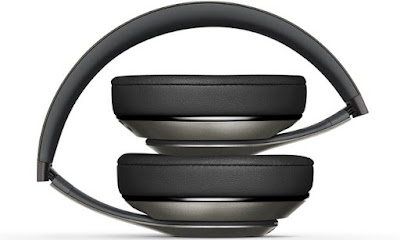

The Beats Studio Wireless fold up into a more compact package.
Like the standard Studio (2013), this model has no "visible" screws, which is good, because those tiny little screws on the headband of the original had a habit of unscrewing themselves and falling out. However, when you break the headphones down -- they fold up (though not flat) to fit in a nice carrying case -- you'll notice Torx screws on the joints on each side of the headband. That joint does have some metal in it and snaps nicely into place when you unfold the headphones.
Beyond that carrying case, you get a few other extras, including both a straight cord for wired listening and one that integrates an Apple-friendly remote and microphone for cell-phone calls. (The remote features may not work with non-Apple devices, but the microphone will.)
Unfortunately, the cords come in red for all models, so there's a little bit of color clash when, say, you get the blue model and end up with a red cord. For $379.95, you should probably get cords that match the color of the headphones. Still, these are wireless headphones, and the vast majority of people will stow away those extra cords (except maybe the USB cable) and never use them, so color won't matter too much. However, it is worth noting that the headphone' internal battery has to have some charge for the headphones to work, wireless or wired.

Even though this is a wireless headphone, you do get extra cords (and a USB cable).
On the inside, there's a new, "improved" DSP (digital signal processor) and software that Beats has, for marketing purposes, dubbed the Beats Acoustic Engine. These are active noise-canceling headphones, and they come equipped with two modes of "adaptive" noise cancellation. According to Beats, one mode is for music listening and offers "balanced" adaptive noise cancellation between your music and your environment, and the other mode offers stronger noise cancellation for when you're disconnected and just want to shut out the world (you can't play your music in this mode).

To power the Bluetooth and noise-cancellation circuitry, there's an integrated rechargeable lithium battery that you juice up via a Micro-USB connection (a cable is included -- again red). Battery life is rated at 12 hours of wireless listening and 20 hours of wired listening. A five-light LED "battery fuel gauge" under the power button on the right earcup indicates how much charge is left, and if you have an iOS device, a tiny battery gauge appears on your device next to the Bluetooth icon in the top right of your screen (as it does with all Bluetooth audio devices).

On the right earcup there's an LED battery-life indicator below the power button.

Like other stereo Bluetooth headphones, this model has a built-in microphone, and I thought the Beats Wireless worked very well as a wireless headset for making cell phone calls. Callers said they could hear me reasonably well, even when I was walking on the noisy streets of New York City on a fairly windy day.
The circular call answer/end button (with the Beats logo on it) is the middle of the left earcup and doubles as a one-button remote for music playback. Tap it once and it pauses your music. Tap it twice quickly and it advances to the next track. Three quick taps sends you back a track. Volume controls are also on the the same earcup, above and below the one-button remote.
Last but not least, there's an auto on/off feature for automatic shutdown once you unplug the headphones if you have them in corded mode. But beware of leaving them connected to your phone in Bluetooth mode and not turning them off. They will most likely run out of juice overnight.

Performance
The original Studio model led to the rise of headphones that overemphasize the bass and wasn't really true to its name ("studio" headphones are supposed to be accurate). As with the updated 2013 wired studio model , Beats has gone to a better balanced sound profile that doesn't overwhelm you with bass.
I described the new standard Studio (2013) as "exciting," with lots of detail and bass energy. If anything, that headphone has some treble push. That hyped sound can be advantageous for mobile listening, where ambient noise can creep in and compete with your music. (Note: the headphones do leak some sound at higher volumes.)
The Studio Wireless also has some excitement to it, but it's a little more subdued of a headphone with less push to the treble, which gives it a smooth, fairly accurate sound. The bass is punchy without feeling over accentuated and the midrange (vocals, acoustical material) is forward leaning, though only slightly so.
It's a pleasant headphone to listen to, and one you can listen to for long periods, but it's not necessarily one that makes you hear things in your music that you haven't heard before.
Of course, for those folks who don't use so-called premium headphone on a regular basis, the experience may be quite different. But having listened to my fair share of high-end headphones, the Beats Studio Wireless isn't terribly special -- at least when compared to decent wired headphones in the $200-to-$400 price range.
But the key here is that this is a wireless Bluetooth headphone, and there isn't too much out there that sounds really good in the Bluetooth realm. For the money, I like the Harman Kardon BT , but its metal design and fit aren't for everybody. Another comparable model in this price range is the Nokia purity pro by monster , which offers very good Bluetooth sound for around $350. And then there's the $250 Bose AE2w, which is arguably the most comfortable of the bunch, though a little gawky from a design perspective. (See CNET's list of top wireless headphones for the current hierarchy.)
I spent the most time comparing the Studio Wireless to the $400 Parrot zik , which offers more high-tech features, including touch-sensitive controls, automatic pause when you take the headphones off your ears, and an app that allows you to tweak the sound profile. (Another comparable model in this price range is the Nokia purity pro by monster , which also offers very good Bluetooth sound for around $350).
I like the Ziks' sound, but I thought the Beats Studio Wireless sounded a little more natural, with tighter bass (all these types of headphones risk making your music sound digitally "processed"). I also thought the lighter Beats headphone was more comfortable to wear. Though it's a relatively large headphone, it is usable at the gym and is more stable on your head than the Zik, making it better for active wear (no, it isn't sweat-proof, but it seems to handle a small amount moisture without a problem).
If you're wondering if this headphone sounds better in wired mode, the answer is no. Headphones that feature active noise canceling and Bluetooth tend to be tuned for listening under those conditions, and I thought these sounded more vibrant in Bluetooth mode.
It is worth mentioning that, just like most of the other noise-canceling headphones we've tried, the Studio Wireless' built-in electronics introduce a small amount of hiss to the sound that's barely audible in quiet rooms. Of course, you don't need noise cancellation in quiet rooms, but you can't turn the noise-canceling circuitry off and get any sound out of the headphones; it has to be engaged for them to work.
I should also add that the noise canceling isn't as effective as that in the bose QuietComfort 15, which is better suited for airplane use. The noise canceling in the Beats offers more modest muffling (while you're listening to music). It worked well for me when I was on the noisy streets of New York, providing a little extra layer of noise cancellation on top of the passive noise cancellation that its snug over-the-ear design provides.

Conclusion
I don't know too many people who would call the Beats Wireless a bargain at $379.95. For what they are, they should probably cost less, but the market is what it is, and plenty of people seem willing to ante up the dough for Beats-branded headphones (and Bose headphones, for that matter).
On a positive note, these Beats are significantly better than the original (circa 2010) Studio and the old $279.95 Wireless on-ear. So while you're paying a premium for the brand, I think the majority of people will be very pleased with both the sound and fit of these headphones. And if I were choosing between this and the standard Studio (2013), I'd pay the extra $80 to get the wireless option. You don't lose anything on the performance front, and the convenience of cutting the cord is worth it, even if the price seems steep.